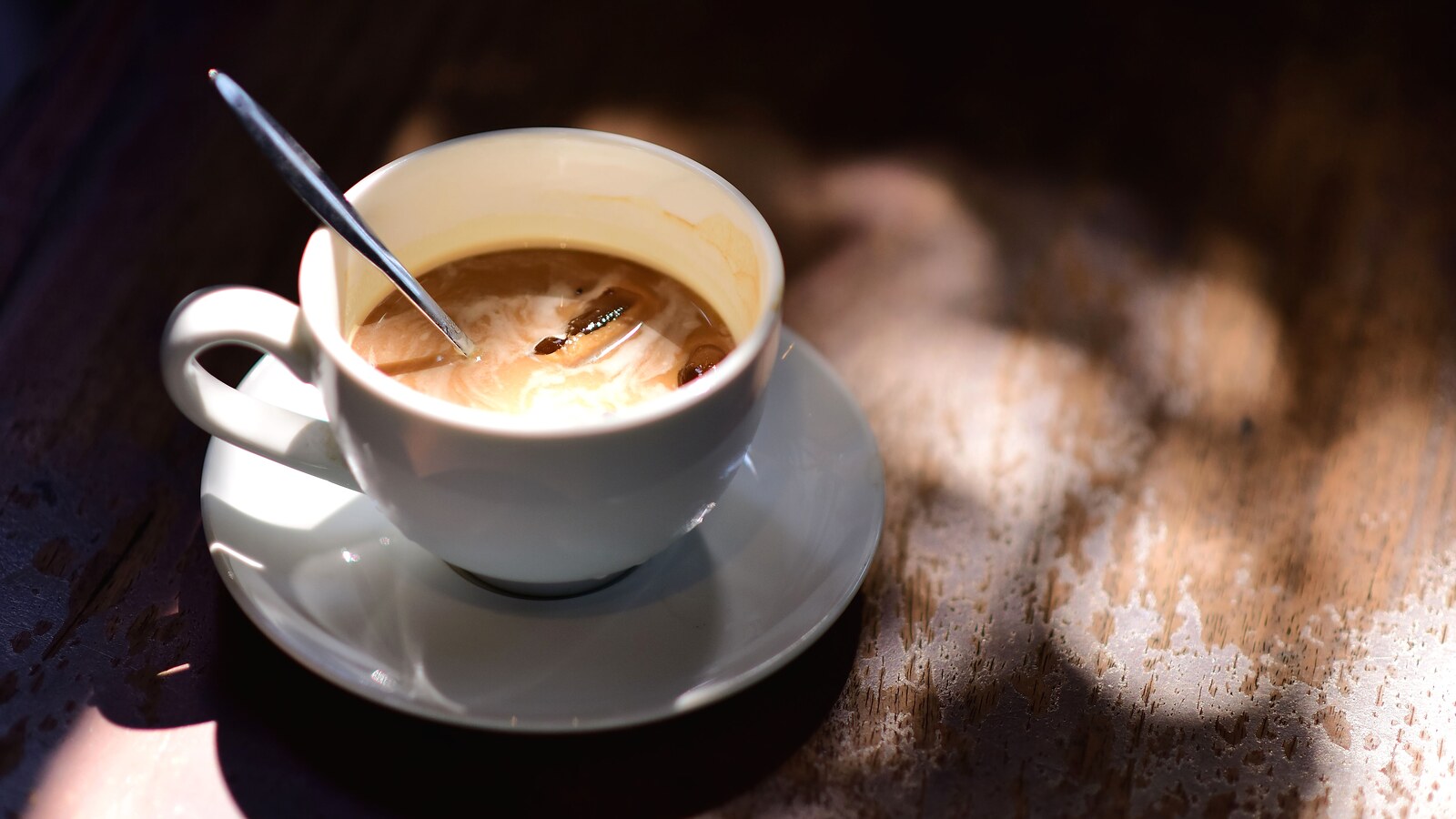
The promise arrives in a particular voice. A banana, a spoonful of ground cumin, thirty minutes before bed. Do that and you will fall asleep quickly and stay deeply asleep until morning.
The problem with it is not the banana. It is the thirty minutes.
Almost every sleep trick shares that shape: an intervention placed as close to bedtime as possible, on the assumption that sleep is made at bedtime. Deep sleep is not made at bedtime. By the time you are standing in the kitchen at half past ten, the size of it has largely been decided, and the decision was made in the afternoon.
What “deep sleep” actually refers to
It is a real thing with a technical name. Slow-wave sleep is the stage that shows up on an EEG as large, slow, synchronised waves, and it is concentrated in the first half of the night.
What matters here is how it is regulated. Slow-wave sleep is not something the body produces on request. Its intensity tracks how long, and how hard, you were awake beforehand — sleep pressure builds across the waking day and discharges during the deep stages. The molecule that carries that signal is adenosine, which accumulates in the brain while neurons work and is cleared while you sleep.
Which means deep sleep behaves less like a nutrient and more like a debt. You do not add it at bedtime. You arrive at bedtime having accrued it, or having spent it.
How to read this
Sleep pressure and circadian timing are two separate systems, and most advice blurs them. Pressure is about how long you have been awake. Timing is about where your body thinks it is in the day.
Nearly everything in this article is about the first one, because that is the system the food tricks claim to act on and the one they are least able to reach.
The hour that decides it is not the one you are thinking of
In 2013, Christopher Drake’s team at the Henry Ford Sleep Disorders and Research Center ran a simple experiment. Twelve healthy sleepers took three pills a day for four days — one six hours before bed, one three hours before, one at bedtime. On any given day, exactly one of the three contained 400 mg of caffeine, roughly two or three cups of coffee. The others were placebo.
Caffeine at bedtime disrupted sleep, which surprised nobody. Caffeine three hours before disrupted sleep. And caffeine six hours before — a coffee at four in the afternoon for someone going to bed at ten — reduced measured total sleep time by more than an hour.
6 hours
before bed, 400 mg of caffeine still cost more than an hour of measured sleep — and the sleepers’ own reports did not register the loss
That last part is the finding worth carrying around. The disruption was objective and the participants could not feel it. They rated their sleep as fine. Anyone assessing their own caffeine tolerance by how they feel is using an instrument the study showed to be broken.
There is a mechanism underneath it, and it is unusually direct. Caffeine works by blocking adenosine receptors. It occupies the site where the sleep-pressure signal would otherwise land. So the afternoon coffee is not vaguely stimulating in a way that lingers — it is interfering with the exact molecular signal that generates slow-wave sleep.
What this study cannot tell you
Twelve people. All healthy, all normal sleepers, all given 400 mg in one dose — more than most people drink at four in the afternoon, and taken all at once rather than across a morning.
It establishes that the effect is real and that self-report misses it. It does not establish your personal cut-off time. Caffeine metabolism varies severalfold between people, largely genetically, and no study can hand you your own number.
The mechanism the bedtime snack gets backwards
The tryptophan story is told constantly and almost always in the wrong direction. Tryptophan is the precursor to serotonin, serotonin is the precursor to melatonin, and bananas contain tryptophan. The chain is real. The inference from it is not.
Brain tryptophan does not track how much tryptophan you ate. It tracks the ratio of tryptophan to the other large neutral amino acids, because they all compete for the same transporter across the blood–brain barrier. Tryptophan is among the scarcest of them in most foods, so it usually loses.
Fernstrom and Wurtman found this out the hard way in the early 1970s, by predicting the opposite. A high-protein meal contains more tryptophan and delivers less of it to the brain, because everything it competes with rises further. A carbohydrate does better, because the insulin response pulls the competitors out of circulation and leaves tryptophan behind.
So a banana is not useless here, but the reason given is inverted. Whatever a banana does, it does as a carbohydrate, and its own tryptophan is the least relevant thing in it. The cumin is doing nothing to that arithmetic at all.
The studies the trick borrows its authority from
Two get cited more than all the others, and neither says what it is quoted as saying.
The kiwifruit study is from 2011: twenty-four adults with sleep complaints ate two kiwifruits an hour before bed for four weeks. The reported improvements were large — sleep onset latency down 35%, sleep quality scores down 42%.
The design was free-living and self-controlled. No control group, no placebo, no blinding. Everyone knew they were eating kiwifruit for their sleep, and most of what was measured was what they said about their sleep afterwards.
The tart cherry study is better built — twenty adults, placebo-controlled, with urinary melatonin measured rather than assumed. It found a real increase. The trouble is the size of the dose it is used to justify: the melatonin in a serving is on the order of a tenth of a milligram, against the one to five milligrams in a supplement people take precisely because they think a tenth would do nothing.
Neither of these is bad science. They are small early studies doing what small early studies do. They became a genre because the conclusion was pleasant, not because the evidence grew.
What has better evidence, and how boring it is
The best-supported bedtime intervention is not a food. In 2019 a team at UT Austin screened more than five thousand papers on passive body heating and pooled the thirteen with comparable data. Warm water at 40–42.5 °C, one to two hours before bed, for as little as ten minutes, shortened the time taken to fall asleep and improved sleep efficiency.
The timing is the interesting part, and it is not what most people assume. A warm bath does not work by making you warm. It pulls blood to the surface of the skin, which sheds heat, and the resulting fall in core temperature is the signal the body uses to begin sleep. Do it immediately before bed and you get the warming without the cooling. The hour or two of lead time is the whole mechanism.
- Set a caffeine cut-off by the clock, not by feel. Eight hours before bed is conservative, six is the tested boundary, and your own sense of it is not evidence — the study’s participants could not detect an hour of lost sleep.
- Protect the wake time, not the bedtime. Sleep pressure is built by hours awake. A consistent rise does more for the depth of the next night than anything available at ten in the evening.
- Move the bath or shower earlier. Ninety minutes before bed, not five. The cooling afterwards is the active ingredient.
- Let the room get cold. Same physiology, arrived at from the other side: core temperature has to fall, and a warm room resists it.
- Treat alcohol as a sedative, not a sleep aid. It shortens the time to fall asleep and degrades the second half of the night. Feeling like it works is exactly the confusion the caffeine study exposed.
Only the first of those is worth measuring, and it is the one people are most confident they already know the answer to.
Try this
For one week, write down the time of your last caffeine of the day. Nothing else. Not how you slept, not how you felt, not whether you think it affected you.
Most people find the number is later than they would have guessed, and that it moves around by two or three hours depending on the day. That variability is the finding, because the thing you are trying to keep steady is the pressure that builds before bed.
You are not testing whether caffeine affects you. That has been tested. You are finding out what time you actually stop.
The parts of this that are genuinely hard
Slow-wave sleep declines with age, substantially, and no behaviour reverses that. The advice above protects what you have. It does not restore what the decade took, and anything promising otherwise is selling something.
There is also a line worth naming. Struggling to sleep occasionally is not insomnia. Insomnia is a clinical condition with a first-line treatment that is not a supplement and not a food — cognitive behavioural therapy for insomnia outperforms sleeping medication over the long run and is what sleep medicine actually recommends. If the problem has lasted months, the answer is not in the fruit bowl and looking for it there costs time.
The bottom line
Deep sleep is not a thing you can add in the last half hour. It is built by the length of the day behind it and protected by not spending it in the afternoon, and the strongest single lever anyone has measured is a coffee you have already forgotten drinking.
The banana will not hurt you. It is just working the wrong shift.
Sources (6)
Every factual claim in this article comes from one of these sources.
- Caffeine effects on sleep taken 0, 3, or 6 hours before going to bed
- Before-bedtime passive body heating by warm shower or bath to improve sleep: a systematic review and meta-analysis
- Large neutral amino acids: dietary effects on brain neurochemistry and function
- Effect of kiwifruit consumption on sleep quality in adults with sleep problems
- Effect of tart cherry juice (Prunus cerasus) on melatonin levels and enhanced sleep quality
- The adenosine-mediated, neuronal-glial, homeostatic sleep response
Keep exploring
Continue reading
Deeper into what you just read.

Explore more
Adjacent ground, if this was useful.

One thing worth knowing
A surprising finding. The evidence behind it. And what it means for your life. BetterYou+ sends one useful idea at a time—nothing to keep up with.