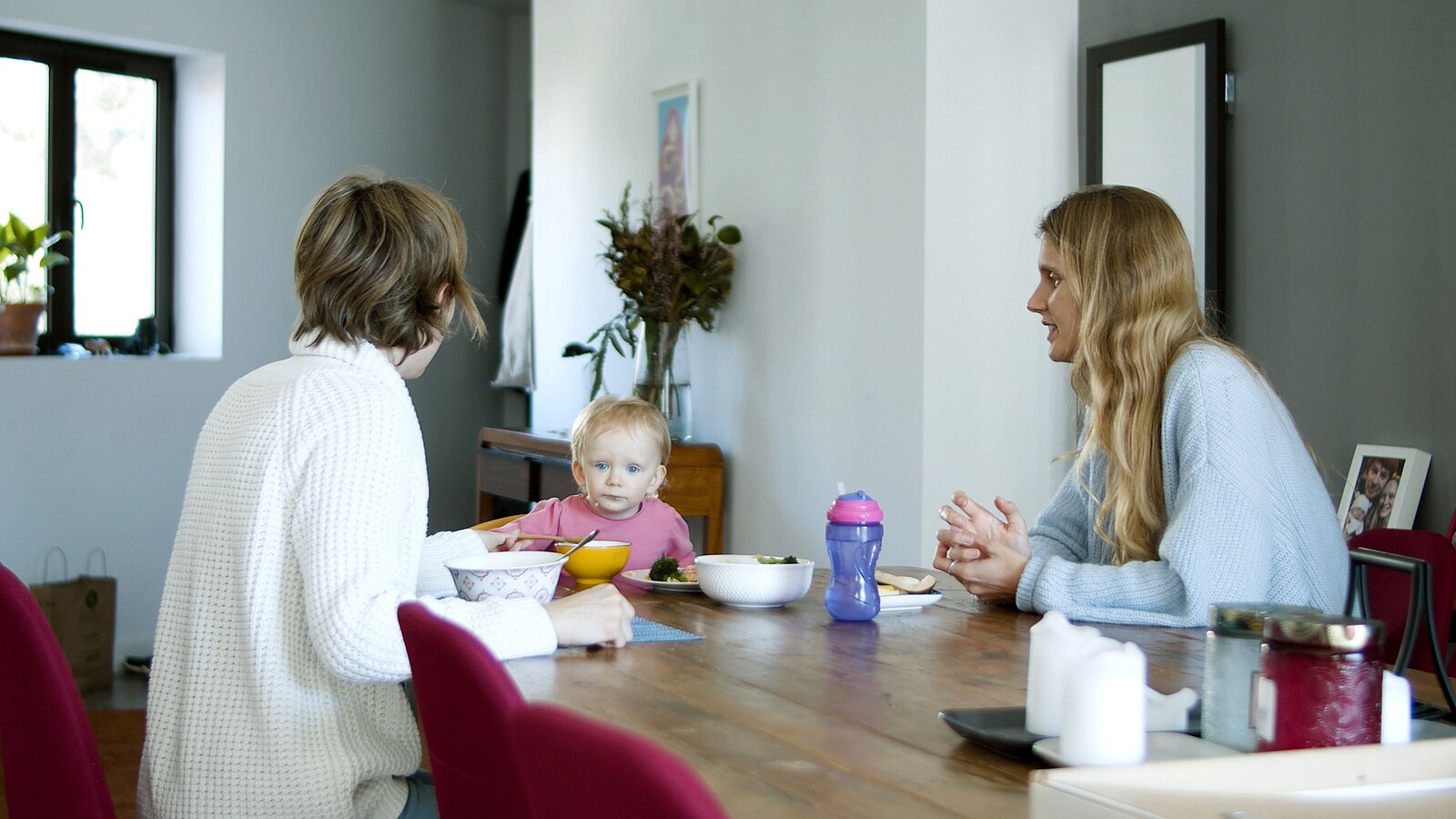
Every guide to family conflict is organised around reducing it. Stay calm, take it elsewhere, do not argue in front of the children, work through the steps until the disagreement is gone.
Thirty years of research on children who watch their parents argue supports almost none of that, and one part of it exactly backwards.
The conflict is not the variable
Start with how much of it there is. In one study, 116 families with children aged eight to sixteen kept records of their disagreements. Mothers reported 1,638 conflicts and fathers 1,281 — and of those, 580 and 377 respectively happened in front of the children.
That is the baseline. Arguing where children can hear it is not an aberration to be engineered away; it is roughly a third of ordinary family disagreement, in families recruited as normal families.
What the study measured was not how many conflicts there were but what children did during them — and the tactics sorted cleanly into two groups.
Two lists
Distressing to children: threat, personal insult, verbal hostility, defensiveness, non-verbal hostility, marital withdrawal, physical distress. Increasing children’s emotional security: calm discussion, support, affection. The second list is not the absence of conflict — it is conflict conducted differently.
Read the second list again. Those are things that happen during a disagreement. They are not what a resolved household looks like afterwards; they are moves inside the argument itself, and children responded to them by becoming more secure, not less.
Leaving the room is on the wrong list
The single most-repeated piece of advice in this area is to take it somewhere else. Look at where withdrawal appears.
Marital withdrawal sits in the distressing column, alongside verbal hostility and personal insult. To a child, a parent who disengages and leaves is not de-escalating; they are producing exactly the thing the research finds children respond badly to.
This is worth sitting with, because the intention behind it is good. The parent who breaks off and goes upstairs is protecting the child from the argument. What the child sees is a disagreement that stopped without being settled, and that ambiguity is the part they carry.
It also explains a familiar contradiction: children in households where parents “never argued” who nonetheless grew up braced for something. Conflict that is moved out of sight does not become invisible. It becomes unexplained.
What these studies can and cannot say
These are observational, and they rest substantially on parents reporting their own conflicts. Parents who conduct disagreements with calm discussion and affection likely differ in many other ways from parents who use threat and insult, and no amount of statistical control fully removes that.
What is stronger than usual here is the cross-reporting: mothers and fathers reported separately, and children’s responses were assessed independently, which makes it harder for a single person’s view of their own family to generate the whole pattern.
Constructive conflict does something positive, not merely less harm
The obvious reading of all this is that some conflict is less damaging than other conflict. The evidence goes further.
A three-wave study followed 235 families whose children were five to seven at the start. It tested a pathway: does constructive conflict act on children through their emotional security, and does that show up in their behaviour later?
It did. Even after controlling for how prosocial the children already were at wave one, emotional security acted as an intervening variable between both constructive and destructive conflict and children’s prosocial behaviour over time.
Both. Destructive conflict ran through emotional security to worse outcomes, and constructive conflict ran through the same channel to better ones. Watching your parents disagree well is not a neutral event that fails to harm you. On this evidence it is an input.
Which makes sense of something the elimination model cannot explain: where else would a child learn what a disagreement between people who are staying together looks like?
What emotional security actually means here
The framework underneath all of this was set out in 1994 and it is worth stating plainly, because it is not the same as “feeling safe.”
The argument is that children monitor their parents’ relationship for information about whether the family is stable, and that their responses to conflict — the vigilance, the intervening, the distress — are attempts to regulate their own sense of security about that.
So a child watching an argument is not primarily upset by the volume. They are running an assessment: is this going to be all right? Tactics that answer that question reassuringly, in the moment, are the ones that show up as increasing security. Tactics that leave it open are the ones that do not.
- Do not aim at zero. A third of ordinary parental conflict happens in front of children in normal families. A house with no visible disagreement is not the control condition; it is usually a house where the disagreement went somewhere else.
- Finish it where it started. Withdrawal is on the distressing list. If an argument begins in front of a child, disappearing mid-way is a worse outcome for them than continuing it calmly.
- Use the second list on purpose. Calm discussion, support and affection are not the aftermath of an argument. They are moves available inside one, and they are what registered as increasing security.
- Let them see the ending. Children are assessing whether things will be all right. An argument they saw start and did not see land leaves the assessment running.
- Stop treating it as damage limitation. Constructive conflict had its own positive path to prosocial behaviour. There is something to be gained here, not merely something to avoid.
Note how little of that is about the subject of the argument. The research is almost entirely about its conduct and its visible ending.
Try this
The next disagreement your children see, change one thing: make the ending visible.
Not a performance and not a lesson. Something ordinary and audible — “we’re not going to agree on this tonight, we’ll sort it tomorrow” — said in front of them, in the same room the argument happened in.
You are not resolving it for their benefit. You are closing an assessment that would otherwise stay open, which on this evidence is the part they are actually tracking.
The parts of this that are genuinely hard
Everything here concerns conflict within the ordinary range. It is not about abuse, and the distinction is not a footnote. Where there is intimidation, coercion or violence, “let them see it resolve” is dangerous advice, and children’s exposure is a safeguarding question rather than a parenting technique.
The conduct advice is also easiest to follow when it is least needed. Calm discussion is available to people who are not yet furious; the moment it becomes valuable is the moment it becomes hard. Nothing in this literature makes that easier, and pretending it does would be the same overselling the article is complaining about.
And the evidence is observational throughout. The direction of the arrow — parents who argue constructively producing more secure children, rather than easier children producing calmer arguments — is supported by the longitudinal design and not settled by it.
The bottom line
The step-by-step guides aim at the wrong target. Arguing where children can hear it is normal, it happens in about a third of ordinary parental conflicts, and the outcome is not decided by the frequency.
It is decided by the tactics and by the ending. Calm discussion, support and affection raised children’s emotional security during conflicts; threat, insult, hostility and withdrawal lowered it. And constructive conflict did not merely fail to harm — it ran through the same channel to better prosocial behaviour years later. Which means the most useful thing you can do with a family argument is not to hide it. It is to let them see it go well.
Sources (4)
Every factual claim in this article comes from one of these sources.
- Children's responses to everyday marital conflict tactics in the home
- Constructive and destructive marital conflict, emotional security and children's prosocial behavior
- Marital conflict and child adjustment: An emotional security hypothesis
- Constructive and Destructive Marital Conflict, Parenting, and Children's School and Social Adjustment
Keep exploring
Continue reading
Deeper into what you just read.

Explore more
Adjacent ground, if this was useful.


One thing worth knowing
A surprising finding. The evidence behind it. And what it means for your life. BetterYou+ sends one useful idea at a time—nothing to keep up with.