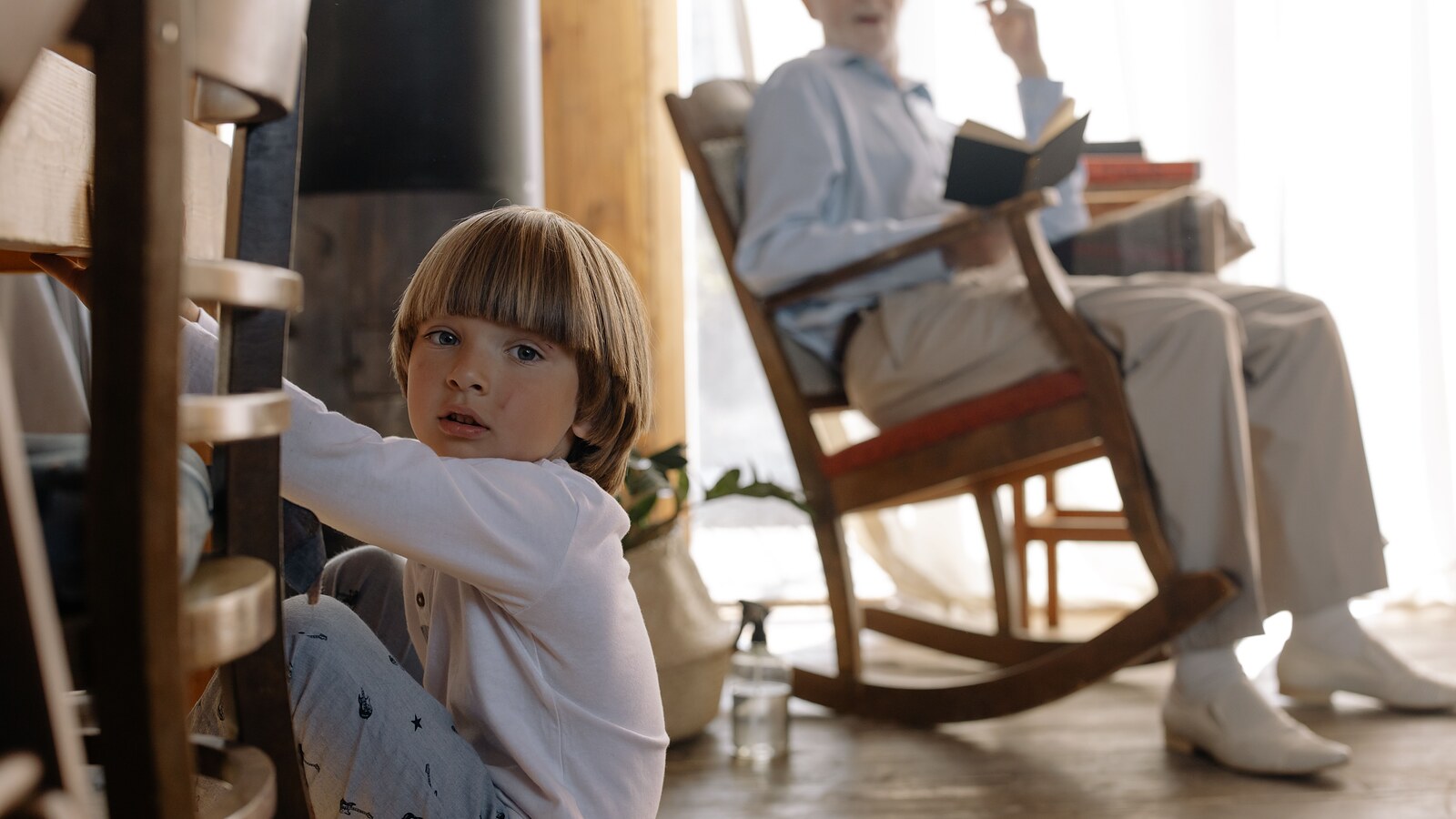
Search for grandparents and grandchildren and you will be handed a list. Bake something together. Plant seeds. Make a memory jar. Record their stories. Do a jigsaw.
None of it is bad advice. It is also, as a body of evidence, almost entirely absent — and the people who reviewed the field say so themselves.
Two hundred and six studies, and a hole where the activities should be
In 2019 a team at Yale ran a global systematic review, registered in advance, of how grandparents influence child health and development. They screened 12,699 abstracts across seven databases and identified 206 studies.
The indicators those studies actually used were three: contact, caregiving behaviours, and financial support. Not activities. Not quality time. Whether the grandparent was there, what care they provided, and what money changed hands.
And the reviewers’ central conclusion is worth quoting almost in full, because it is unusually blunt about its own field: understanding of the pathways through which grandparents exert their influence is constrained by limited data on what grandparents actually do.
So the honest position is that the activity lists are not contradicted by evidence. They are unexamined by it. What has been measured is something simpler and, it turns out, more interesting.
What involvement is associated with, and for whom
Strip away the enrichment framing and a plainer question remains: does having a grandparent around track anything measurable in the child? On that, the evidence is better.
The clearest single study asked the adolescents. In England and Wales, 1,515 secondary school students aged 11 to 16 completed a structured questionnaire about their closest grandparent.
Greater grandparent involvement was associated with fewer emotional problems (p < 0.01) and more prosocial behaviour (p < 0.001). That much is what you would expect.
The part that is not expected is where the association was strongest.
Not evenly
Grandparent involvement was not higher in lone-parent and step-families than in two-parent biological families — the level was the same. But the association between that involvement and reduced adjustment difficulties was significantly stronger for the adolescents in lone-parent and step-families.
The same amount of grandparent, doing more work where there are fewer adults. Which reframes the whole subject: what the involvement supplies is not enrichment on top of a full household. It is capacity in a household that has less of it.
What these studies can and cannot say
Cross-sectional and self-reported, both of them, and the reverse-causality objection is obvious: families that are functioning well have grandparents who visit more, and adolescents who are doing well are easier to be involved with.
The systematic review is candid that the field has this problem structurally. Across 206 studies it found “substantial heterogeneity” in how co-residence, caregiving roles and resources were even recorded — which is a polite way of saying the studies are not measuring the same thing as each other.
The effect nobody puts in the activity list runs the other way
Almost everything written about this relationship treats the grandchild as the beneficiary and the grandparent as the resource. The largest measured effect in the field points the other way.
The Berlin Aging Study followed older adults over time and compared those who provided childcare for grandchildren with those who did not, and with people who had no grandchildren.
Grandparents who provided non-custodial childcare had mortality hazards 37 per cent lower than grandparents who provided none and than non-grandparents. Half the helpers were still alive at around seven years; half the non-helpers at around four.
That is an association, not a prescription, and healthier grandparents are more able to look after children in the first place — the authors did not have an experiment. But the size of it is the point. No craft project has an effect estimate remotely like that, and the direction is one the genre has essentially never considered.
The third indicator nobody writes articles about
Of the three things the 206 studies actually measured, two are the ones you would guess. The third is financial support.
That is a striking thing to find sitting alongside contact and caregiving as a co-equal indicator of grandparent involvement, and it never appears in an article about bonding. Money moving down the generations is part of what the research counts as a grandparent being involved — school costs, a deposit, the gap in a month.
Naming it matters for two reasons. It means some of what looks like a relationship effect in this literature may be a resources effect wearing a relationship’s clothes, and the studies are rarely designed to tell those apart. And it means families who cannot supply that particular indicator are being compared, in the data, with families who can.
Which is a limitation of the evidence rather than a fact about anybody’s grandparents. But an article that lists baking and gardening while the research counts financial transfers is describing a different subject from the one being studied.
The word doing all the work is “non-custodial”
Every finding above concerns grandparents who are involved, not grandparents who are in charge.
The systematic review’s own categories make the distinction: of 206 studies, 154 concerned multigenerational care, 35 concerned custodial care, and 17 covered both. The field treats them as different subjects, because they are.
Raising a grandchild full-time — often following a family crisis, frequently without legal standing or financial support — is a different arrangement with different consequences for everyone in it, and results about weekly babysitting do not transfer to it. Any article that slides from one to the other is misleading whichever direction it slides.
- Optimise for frequency, not for occasion. What has been measured is contact and care. A short, ordinary, repeated presence is the variable in the research; a memorable annual outing is not.
- If the household has fewer adults, this matters more. The association was strongest for adolescents in lone-parent and step-families. Where a family is stretched, grandparent involvement is not a nice extra.
- Let the grandparent be a person, not a service. The mortality finding attaches to grandparents who help. Framing them purely as childcare misses that the arrangement appears to be doing something for them too.
- Do not let the activity be the point. Nothing in 206 studies establishes that baking beats a jigsaw. What is established is showing up, which is a lower bar and a harder habit.
- Name what kind of arrangement it is. Occasional help, regular childcare and full custody are three different things with three different evidence bases, and treating them as one is the commonest mistake in this subject.
Four of those five are about structure rather than content, which is what happens when you take the advice from what has been measured instead of from what is easy to write a list about.
Try this
Instead of planning an activity, plan a slot: a repeating half-hour that does not depend on anyone being interesting.
A phone call on the way home from school. A Sunday morning that is always the same. Something dull enough to survive a bad week.
The research measures contact. Contact is a scheduling decision, and it is the one input the evidence actually supports.
The parts of this that are genuinely hard
The evidence base is weaker than the confidence of anything written about it, including this. A systematic review that screens 12,699 abstracts and concludes that the field cannot say what grandparents do is not describing a solved problem.
Proximity is also not distributed by choice. Grandparents living in another country, estranged families, illness, work and money all determine involvement far more than intention does, and an article recommending frequency to people who cannot supply it is not much use. The finding that involvement matters most where households are stretched is genuinely double-edged: those are often the families least able to arrange it.
And there is a real tension in the mortality result. It is the strongest argument for grandparents being involved and it can be read as an argument for putting them to work. Both the caregiving literature and common sense say the same thing about the difference between help freely given and care that cannot be refused.
The bottom line
The activities are not the finding. Across 206 studies the field measures contact, caregiving and support, and its own reviewers say the gap in the evidence is precisely what grandparents actually do together.
What survives is narrow and worth acting on: involvement is associated with fewer emotional problems and more prosocial behaviour in adolescents, most strongly where the household has fewer adults — and grandparents who provide childcare had a 37 per cent lower mortality hazard than those who did not. Nobody needs a memory jar. They need a slot in the week.
Sources (3)
Every factual claim in this article comes from one of these sources.
Keep exploring
Continue reading
Deeper into what you just read.
Explore more
Adjacent ground, if this was useful.

One thing worth knowing
A surprising finding. The evidence behind it. And what it means for your life. BetterYou+ sends one useful idea at a time—nothing to keep up with.