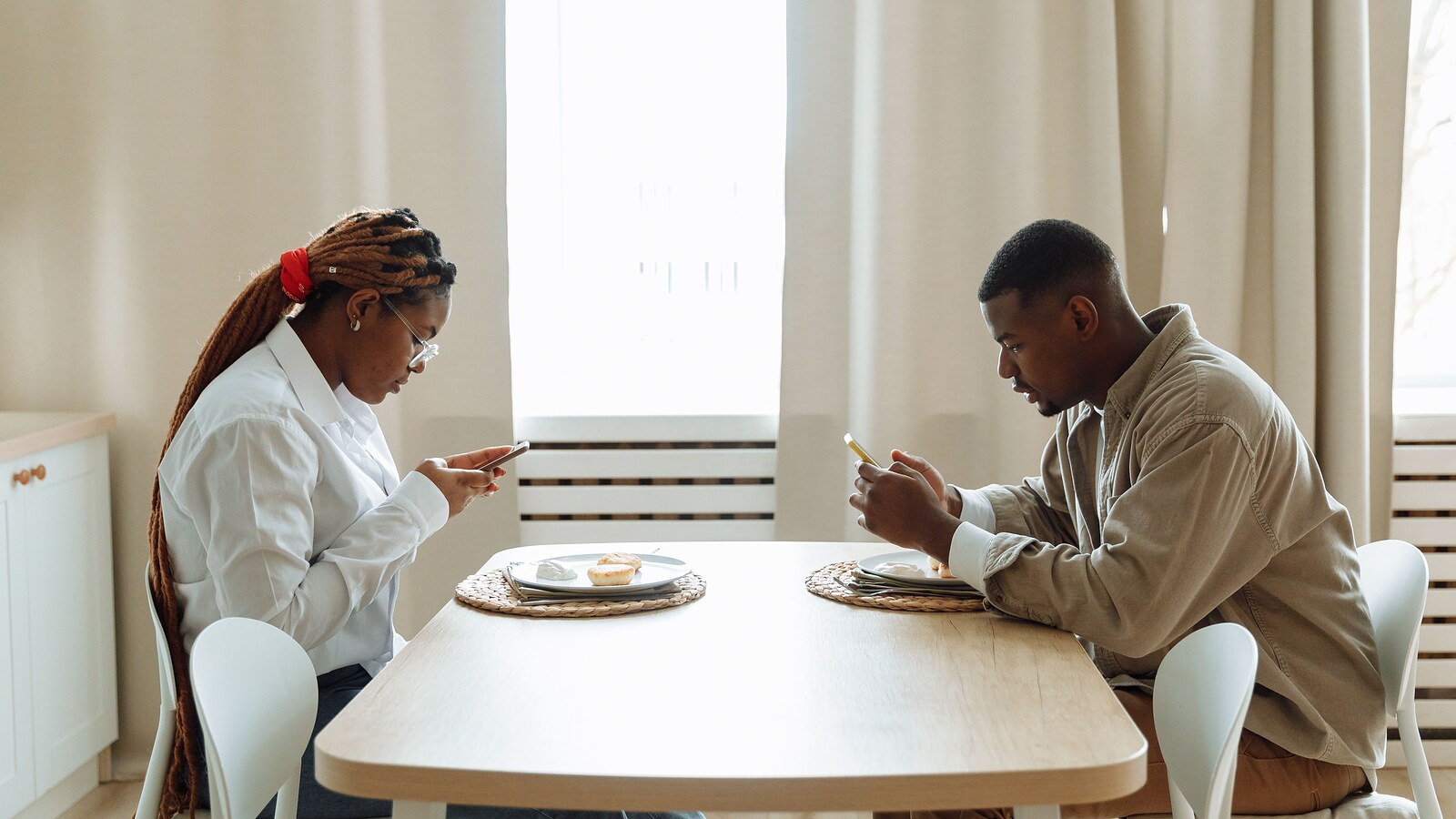
The standard account of social media and relationships is about what your partner sees. Curated holidays, an ex who resurfaces, the slow corrosion of comparing your Tuesday with somebody else’s highlight reel. Jealousy, trust, idealised self-presentation.
The largest pooled analysis of the subject points somewhere much more mundane. The measured damage is not about what is on the screen. It is that the person holding it has left the room without going anywhere.
Fifty-two studies, and conflict is the largest effect
In 2025 researchers pooled 52 studies — 58 samples, 19,698 people — on partner phubbing: the extent to which someone is on their phone while in the company of the person they are with.
Relationship satisfaction came out at rz = −0.219. That is the number the headlines use. But it is not the biggest thing in the table.
0.573
The pooled association between partner phubbing and conflict — more than twice the size of its association with relationship satisfaction, and the largest consequence measured. Alongside it: intimacy quality at −0.267, partner responsiveness at −0.292, and jealousy at 0.289.
Read those together and the mechanism reorders itself. The strongest signals are conflict and the collapse of responsiveness — the sense that your partner registers you and reacts. Jealousy, the thing the entire genre is written about, sits below both.
This is a phone-in-the-room problem far more than it is a what-is-on-the-phone problem.
The thing that best predicts it is not the relationship
The antecedents are more revealing than the consequences, and they are not flattering to the usual story.
The strongest predictor of partner phubbing by a wide margin is problematic media use, at 0.495 — roughly double the next item. Then attachment anxiety at 0.240, depression at 0.185, attachment avoidance at 0.181, and loneliness at 0.136. Low self-esteem did not reach significance at all.
So the person on their phone at dinner is, on the available evidence, mostly displaying a phone habit rather than a verdict on their partner. That is worth knowing before an argument, because the argument usually assumes the opposite.
And attachment anxiety appearing in the antecedent column is a genuinely uncomfortable finding, because partner phubbing is measured by asking people how much their partner is on the phone. The more anxiously attached someone is, the more phubbing they report. Some of what is being measured is how much you notice.
What this meta-analysis can and cannot say
Nearly all of it is cross-sectional and self-reported, and the reverse-causality problem is wide open. An unhappy partner notices the phone more, reports more of it, and reports lower satisfaction — which would produce this entire table with no causal effect of phones at all.
Heterogeneity is also high: I² above 70 per cent for most outcomes, meaning the pooled figures summarise studies that disagree substantially. The exception is partner responsiveness, at 22.5 per cent — the one result the studies broadly agree on, and the one closest to a mechanism.
What does hold up well is robustness to unpublished nulls. The fail-safe N for relationship satisfaction is 2,911 studies.
Your number is probably smaller than the headline
The single largest moderator in the analysis is culture, and the gap is not subtle.
For marital satisfaction, the association in Eastern cultural contexts was rz = −0.604. In Western ones it was −0.178. Same behaviour, same measure, an effect more than three times larger in one group of studies than the other.
Relationship length moderated things too. Which means a pooled average across all of it describes no particular couple, and a reader in a Western country quoting the headline figure is quoting a number that mostly came from somewhere else.
The famous phone-on-the-table study did not replicate
There is one result in this field that has escaped into general knowledge: that the mere presence of a phone on the table — face down, silent, untouched — degrades the conversation happening beside it.
It comes from two experiments published in 2013, in which strangers talked with either a phone or a notebook nearby, and those with the phone reported lower relationship quality.
In 2021, researchers at HEC Paris ran a close replication with 356 participants across 136 groups, following the original procedure. They failed to replicate the effect on relationship quality in both studies, and found no effect on creativity either. Another team had already failed to find it. Their conclusion was measured: the effect is at minimum much harder to find than the literature assumed.
That matters for what you do about any of this. If the mere presence of a phone were corrosive, the answer would be banishing devices from rooms. The evidence that survives is about a phone being used, in company, by a person who has stopped responding — which is a behaviour, not an object.
- Aim at responsiveness, not at screen time. The one outcome the studies agree on is the sense that your partner registers and reacts to you. Rules about hours do not touch it; looking up does.
- Do not read the phone as a message about you. The strongest predictor of phubbing is the person’s own media habit, at roughly double any relationship variable. It is usually a habit being displayed near you rather than at you.
- Notice that noticing is part of the measurement. Attachment anxiety predicts reporting more partner phubbing. If it feels constant, that is real information — about the relationship, or about the week you are having, and it is worth knowing which.
- Expect it to show up as conflict first. The largest association in the whole analysis is with conflict, not dissatisfaction. Arguments that seem to be about something else are the early signal.
- Do not banish the object. Face-down on the table is not the finding, and the finding that said so has twice failed to replicate.
The practical shape of that is smaller than a digital detox and harder than one: not fewer devices in the house, but a reliable answer when someone speaks.
Try this
For a week, do not change anything about when you use your phone. Change only one thing: when the person you are with says something, put it down before you answer, not after.
The screen time will be identical. What changes is the measure with the lowest disagreement across the whole literature — whether you appear to be someone who responds.
If that feels like a small intervention, it is. It is also the only variable in the table that the studies broadly agree on.
The parts of this that are genuinely hard
The causal direction is the honest weak point and it will not be resolved by more cross-sectional surveys. Everything here is compatible with phones damaging relationships, with unhappy relationships producing more phone use, and with both at once. The literature has not separated them.
The measure itself is also doing more work than its name suggests. “Partner phubbing” is one person’s perception of another’s behaviour, gathered on a questionnaire, and perceptions of a partner are notoriously coloured by how the relationship is going. That is not a fatal objection, but it means the numbers describe an experience rather than an activity log.
And there is a quieter difficulty in the antecedents. If the strongest predictor of phubbing is problematic media use, then for some couples this is not a relationship problem being solved by relationship advice. It is a compulsion, sitting in the middle of a relationship, and it needs to be addressed as one.
The bottom line
Social media does not damage relationships mainly through what people see on it. Across 52 studies, the biggest measured consequences are conflict and the loss of responsiveness — the specific experience of speaking to someone who is present and not available.
The object on the table is not the problem; two failed replications say so. The person who does not look up is.
Sources (4)
Every factual claim in this article comes from one of these sources.
- A meta-analytic study of partner phubbing and its antecedents and consequences
- My life has become a major distraction from my cell phone: Partner phubbing and relationship satisfaction among romantic partners
- Can you connect with me now? How the presence of mobile communication technology influences face-to-face conversation quality
- How bad is the mere presence of a phone? A replication of Przybylski and Weinstein (2013) and an extension to creativity
Keep exploring
Continue reading
Deeper into what you just read.


Explore more
Adjacent ground, if this was useful.


One thing worth knowing
A surprising finding. The evidence behind it. And what it means for your life. BetterYou+ sends one useful idea at a time—nothing to keep up with.