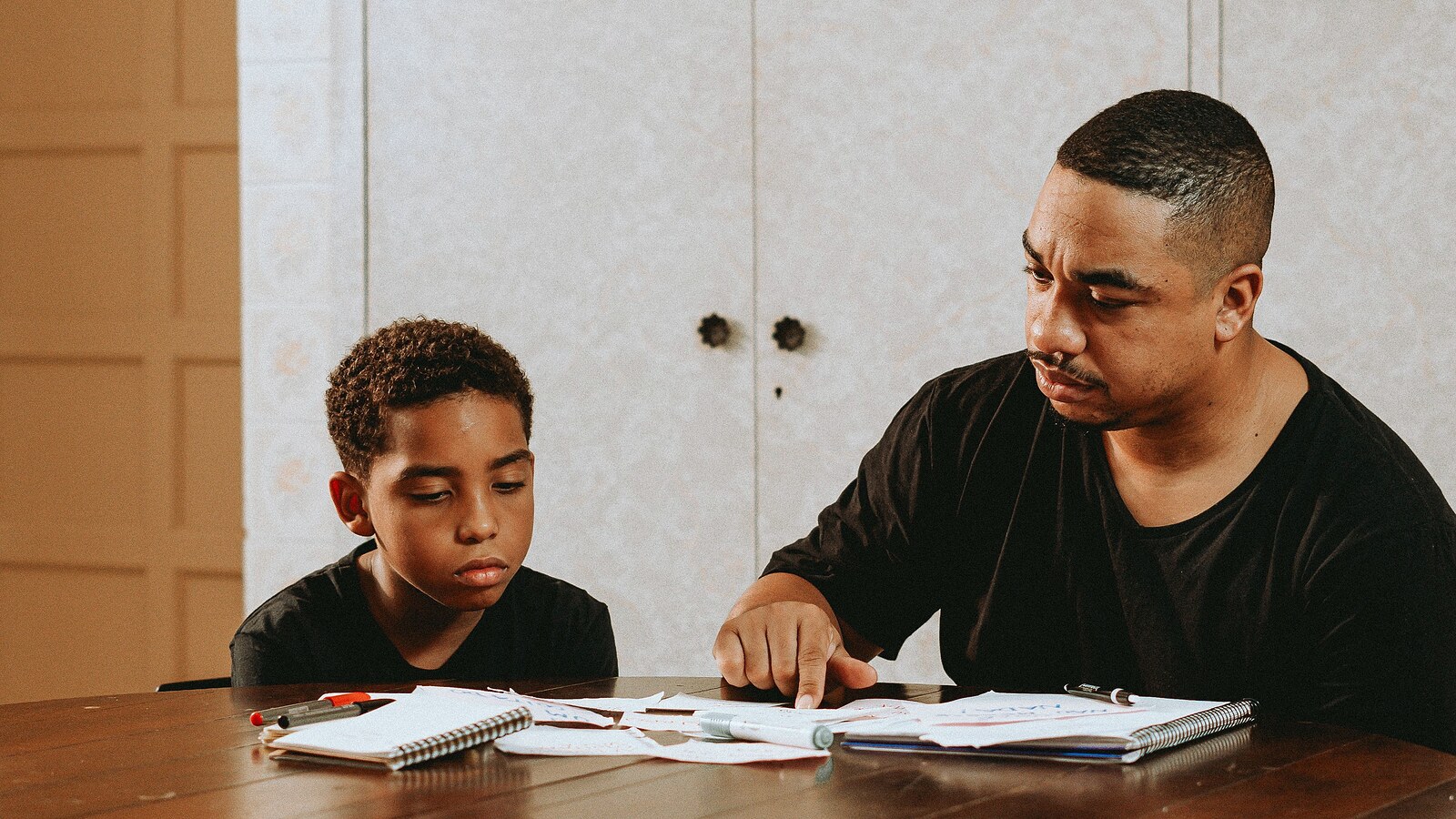
Two parents help a nine-year-old with the same piece of homework, for the same forty minutes, with the same patience. One of those children will be measurably better at working alone next year. The other will be worse.
The difference is not how much help arrived. It is where the decision stayed.
This is the part of “raising independent children” that the advice usually skips, because the advice is almost always about quantity: step back more, hover less, let them fail. Quantity is the wrong axis. A parent can be deeply involved and produce independence, or barely present and produce none.
The two things that look identical from outside
Developmental psychology has a name for each, and they are not opposites on a dial. They are different behaviours that can occupy the same forty minutes.
Autonomy support is help that leaves the child holding the problem. It looks like offering options, explaining reasons, acknowledging that the task is genuinely annoying, and letting the child choose the order they do things in.
Psychological control is help that takes the problem away and attaches a condition to it. In Wendy Grolnick’s work it has a specific and uncomfortable definition: guilt induction, love withdrawal, and shaming. Not shouting. Not rules. The quieter register — after everything I do for you, the cooled voice, the disappointment held just long enough to be felt.
How to read this
These are research constructs, measured with questionnaires, not a diagnosis of anyone’s parenting. Most parents do both in a single week, and doing the second one occasionally is not a finding about your character.
What the research supports is narrow and useful: the two produce different outcomes, and they are distinguishable in the moment if you know what to listen for.
What the difference actually does
In Grolnick’s studies, children who had just worked with an autonomy-supportive mother persisted longer at solving problems on their own than children who had worked with a controlling one. Same help. Same duration. Different residue.
The effect does not stop at homework. Schiffrin and colleagues surveyed 297 college students in 2014 and found that those reporting over-controlling parents had significantly higher levels of depression and lower satisfaction with life — and the effect ran, statistically, through exactly the channel the theory predicts. It was not the involvement that hurt. It was the perceived violation of the students’ need to feel autonomous and competent.
297
college students; over-controlling parenting predicted more depression and less life satisfaction, explained by unmet needs for autonomy and competence
What this study cannot tell you
It is cross-sectional and self-reported. Everything was measured once, by asking students. That design cannot establish that the parenting caused the depression, and the reverse is entirely plausible: a student who is depressed may recall and describe a parent as more controlling than a sibling would.
It is good evidence that the two travel together, and that the autonomy channel is where the association lives. It is not evidence that a particular parent caused a particular outcome.
The tell, in the moment
The practical value of the distinction is that it is audible. Both parents say something in the forty minutes, and the sentences are different.
Control attaches the child’s standing to the outcome. I don’t understand why this is so hard for you. Do you know how lucky you are to have someone who helps? Fine. Do it your way. Each of those moves the stake from the task to the relationship.
Autonomy support leaves the stake on the task. This bit is genuinely boring, and it still has to be done. Do you want to start with the hard one or get the easy ones out of the way? I can sit here or I can go — which helps more?
Notice that none of the second set involves stepping back. Two of them are offers to stay.
Where the balance actually sits
If involvement is not the variable, the familiar advice to “let them struggle” is only half a rule — and on its own it is a poor one, because withdrawal can be its own form of control. Fine, do it your way is not autonomy support. It is love withdrawal with a helpful face.
- Give the reason, not just the rule. The reason is what a child can carry to a situation you are not in. A rule only works where you are standing.
- Offer a real choice inside the non-negotiable. Bedtime is not up for discussion; which book, which order, which pyjamas can be. The choice is not a trick — it is the part they practise on.
- Acknowledge the difficulty out loud. “This is boring” costs you nothing and removes the argument about whether it is boring, which is the argument you were about to have.
- Ask what kind of help is wanted before supplying it. “Do you want me to look at it, or do you want to finish it first?” keeps the problem with them while making you available.
- Watch for the conditional. If your help arrives with a debt attached — spoken or otherwise — it is doing the other thing, whatever it looks like from the doorway.
Try this
For one week, notice only the sentence you use when you sit down to help. Not the amount of help. Not whether you should have offered. Just the sentence.
Most parents find one of two patterns, and both are habitual rather than chosen:
“Right, show me what you’ve done.” — which takes custody of the work.
“Where do you want to start?” — which does not.
The second sentence is not more permissive. It takes the same forty minutes. It just leaves the problem where it can do some good.
The parts of this that are genuinely hard
Autonomy support is more expensive than control in the short run, and anyone who tells you otherwise has not tried it on a Tuesday at 6pm. Offering a choice takes longer than issuing an instruction. Letting a child order their own homework badly costs an evening. Control is faster, and it works — tonight.
The research is not a claim that the fast option is never available to you. It is a claim about what accumulates. The forty minutes is the same either way; what differs is what is left in the child when it ends.
The bottom line
Independence is not something you create by being absent, and it is not something you spend by being present. It is built in the specific moment when a child is stuck and someone decides whether the problem stays theirs.
You can stay in the room for that. Most of the time you should.
Sources (3)
Every factual claim in this article comes from one of these sources.
Keep exploring
Continue reading
Deeper into what you just read.


Explore more
Adjacent ground, if this was useful.


One thing worth knowing
A surprising finding. The evidence behind it. And what it means for your life. BetterYou+ sends one useful idea at a time—nothing to keep up with.